
13 nights
From
£3,499
pp

We've lost count of how many times we've heard a first-time visitor say "I didn't realise the North Island was this varied." And it's true — in the space of a fortnight you can walk through ancient kauri forest, watch a geyser erupt on schedule, taste world-class pinot noir, and stand on a beach so remote you'll need a boat to reach it. Having planned North Island itineraries for over two decades, we think it's genuinely one of the most underrated halves of any long-haul destination we sell. Here's our region-by-region guide to what makes each part of it worth your time.

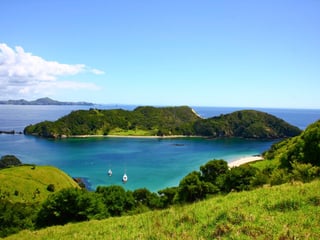
Setting: Stretching from Auckland to the very top of the country, Northland is a subtropical stretch of giant kauri forest, layered history and some of the best sailing water anywhere in the South Pacific — the Bay of Islands is genuinely one of the finest places on the planet for diving, big-game fishing and simply pottering about on a boat. This is also where Maori explorer Kupe is said to have first arrived by waka, navigating purely by stars and ocean currents.
See and do: Head to Dargaville for kauri forest and wild west coast beaches, Whangarei for its sheltered bays, Kaitaia for the sweep of Ninety Mile Beach, and Cape Reinga at the very tip, where the Tasman Sea and Pacific Ocean visibly collide. The boutique towns of Opua, Paihia, Russell and Kerikeri anchor the Bay of Islands itself — 144 islands scattered between Cape Brett and the Purerua Peninsula.
Star attraction: The Waitangi Treaty Grounds is the essential stop for understanding the Treaty of Waitangi, signed here in 1840. A full-day guided visit takes in the Treaty House and Museum, a Maori cultural performance in an authentic meeting house, the 35-metre ceremonial war canoe, and views across the bay that make the history feel properly rooted in place.
Discover the Bay of Islands on our North to South and All That's Inbetween self-drive.

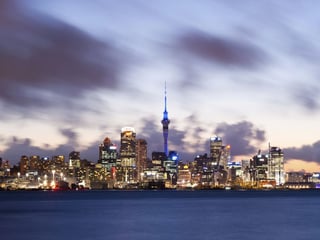
Setting: Home to a third of New Zealanders, Auckland sits on a narrow isthmus between two harbours — the Waitemata on the Tasman side, the Manukau on the Pacific. It's the largest Polynesian city in the world, and it earns its reputation for liveability with white-sand beaches minutes from downtown, a genuinely excellent dining scene, and views from the 328-metre Sky Tower or the 196-metre summit of Mount Eden, the highest of the city's volcanic cones.
See and do: After taking in the Harbour Bridge, the Auckland Art Gallery holds a strong collection of New Zealand, Maori and Pacific work. The Auckland Museum's 1,000-plus taonga (treasures) reward a slow visit, while Kelly Tarlton's SEA LIFE Aquarium, the National Maritime Museum and Auckland Zoo round out a family-friendly few days.
Star attraction: One Tree Hill, an extinct 182-metre volcano, holds real historical weight — a 30-metre obelisk marks John Logan Campbell's grave and Auckland's 1940 centenary. The original tree was felled in 1852, but the 360-degree views and picnic slopes in the adjoining Cornwall Park still make it worth the climb.
Auckland features on nearly every one of our self-drive tours as a natural starting point.

Setting: Jutting into the Pacific east of Auckland across the Hauraki Gulf, the Coromandel earns its beach-paradise reputation honestly — a forested mountain spine runs down its centre, flanked by coastline on both sides. The Kauaeranga Kauri Trail, better known as the Pinnacles Walk, is one of the best single-day hikes in the region.
See and do: Coromandel Town's School of Mines Museum tells the area's gold rush story, before the inevitable pilgrimage to Cathedral Cove — arguably the region's most photographed spot. Dig your own hot pool at Hot Water Beach around low tide, explore the swingbridges and rusting mining gear at Karangahake Gorge, and watch thousands of wrybills at the Pukorokoro Miranda Shorebird Centre.
Star attraction: New Chums Beach at Wainuiototo Bay is the one locals rave about — golden sand, clear water and thick native bush, reachable only by boat or a proper walk in. Waihi Beach, five miles of safe surf at the peninsula's southern end, looks out to the dormant volcanic cone of Mayor Island.

Setting: An obvious choice for Peter Jackson's Middle-earth, Hamilton-Waikato rolls through bush-covered hills and ancient river country, with Hamilton itself — New Zealand's fourth-largest city — sitting on the banks of the Waikato River.
See and do: The Waikato Museum, a lakeside picnic at Hamilton Lake, and a Waikato River cruise are all easy additions to a stop here, alongside a guided tour of the glittering Waitomo Glowworm Caves and adventure options from black water rafting to ziplining.
Star attraction: West of Hamilton, Raglan is New Zealand's surfing heartland, with one of the longest left-hand breaks in the world. Beyond watching the surfers, paddle out to Raglan's own layered limestone Pancake Rocks at low tide.
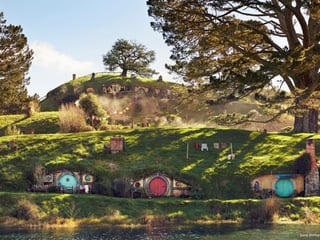
Matamata and Hobbiton feature on our New Zealand Wonderland tour.

Setting: Nowhere does bubbling mud, shooting geysers and volcanic drama quite like Rotorua, on the southern shore of its namesake lake in the Bay of Plenty. The nickname "Sulphur City" is well earned by the smell, but that's a small price for one of the country's richest concentrations of Maori cultural experience — dance, concerts and hangi feasts cooked using the earth's own heat.
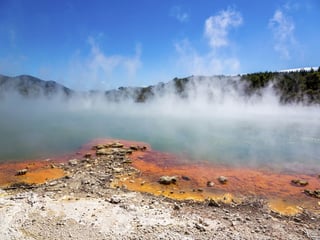
See and do: Wai-O-Tapu Thermal Valley delivers the bright orange and turquoise pools most people picture when they think of Rotorua, alongside steaming fumaroles and silica terraces. The TreeWalk suspension bridge through Redwood Forest, the geothermal drama of Hell's Gate, and white-water rafting down the Kaituna River — home to the world's highest commercially rafted waterfall — round out an action-packed stop.
Star attraction: Villages like Whakarewarewa, Tamaki Maori and Mitai Maori offer genuinely immersive routes into local history and ritual, including hangi feasts and haka performances that carry real weight rather than feeling staged for tourists.
Rotorua and Wai-O-Tapu both appear on our Spirit of New Zealand escorted tour.

Setting: Named by Captain Cook, who was clearly taken with a bay "full of plantations and villages," the Bay of Plenty stretches from Waihi Beach to Opotiki and mixes mountains, orchards and New Zealand's only active marine volcano.
See and do: Mount Maunganui's beach draws surfers, parasailors and sandcastle-builders alike, while the Wairoa River offers proper white-knuckle rafting. Tauranga's Strand waterfront is worth an evening for its restaurants and dolphin tours.
Star attraction: Whakaari (White Island), 30 miles offshore, is New Zealand's most active volcano — a hissing, steaming landscape that draws volcanologists and thrill-seekers alike, though access is tightly managed by tour operators and occasionally restricted, so always check current availability before building it into your plans.

Setting: Also called the East Cape, Eastland is New Zealand's most easterly region — Gisborne is famously the first city on Earth to see the sunrise each day. Rugged headlands, empty bays and a genuinely significant history (the first Polynesian canoes landed here, and Cook made his first New Zealand landfall) define the region.
See and do: The Tiniroto Road between Wairoa and Gisborne takes in Te Reinga Falls and Tiniroto Lakes, while Lake Waikaremoana rewards a proper detour into dense native bush. The Mahia Peninsula is excellent for snorkelling and surfing, and the Morere Hot Springs make a relaxing stop after a hike up sacred Mount Hikurangi.
Star attraction: Gisborne, unofficially New Zealand's Chardonnay capital, combines surf beaches, botanical gardens and a lively wine and cider scene — the Saturday market on Stout Street and the Rere Rockslide are local favourites.
Setting: Dominated by the near-perfect volcanic cone of 2,518-metre Mount Taranaki, this west coast peninsula draws surfers to 12 world-class breaks and hikers to trails like the Pouakai Circuit through Egmont National Park.
See and do: New Plymouth's coastal walkway passes Len Lye's 48-metre kinetic sculpture, Wind Wand, en route to the Cape Egmont lighthouse. The Tupare homestead's gardens and cliff cascade, and the Puke Ariki museum's take on the region's Maori and pioneering history, both reward a slower pace.
Star attraction: Pukeiti, a rainforest garden in Mount Taranaki's foothills, thrives in volcanic soil unlike anywhere else in the country — best seen during the Taranaki Garden Spectacular, held over ten days from late October into early November.

Setting: Home to Mount Ruapehu and two national parks — the UNESCO-listed Tongariro, with its steaming craters and emerald lakes, and Whanganui, built around the country's longest navigable river — Ruapehu draws skiers, botanists and hikers in roughly equal measure.
See and do: The Tongariro Alpine Crossing is one of the best single-day hikes anywhere in the world, crossing active volcanic terrain to views most visitors simply don't expect from New Zealand. In summer, rafting, horse riding and farm bike tours take over; the Raurimu Spiral, an extraordinary feat of railway engineering, still draws train enthusiasts from across the globe.
Star attraction: Ruapehu's mountain biking is genuinely world-class — the Timber Trail follows old logging roads through Pureora Forest Park, while the Mountains to Sea Trail runs from the volcano's slopes all the way to the Bridge to Nowhere in Whanganui National Park.
The Tongariro Alpine Crossing and Tongariro National Park feature on our Kakapo Small Group Tour.

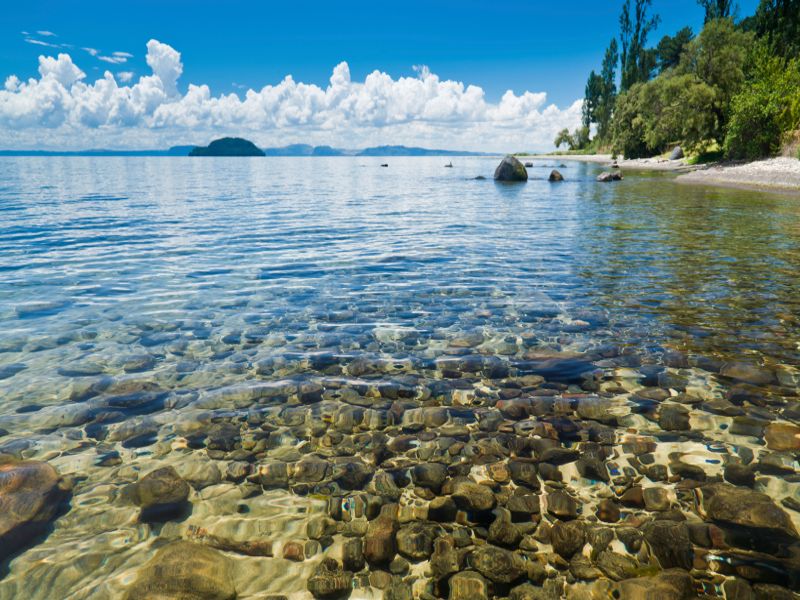
Setting: Life here revolves around Lake Taupo, a 238-square-mile expanse that fills a caldera left by a colossal eruption roughly 26,500 years ago. Alongside its reputation as New Zealand's skydiving capital, Taupo is serious fishing territory — Turangi, at the lake's southern end, is home to the world's largest natural trout fishery.

See and do: The Tongariro River offers more than 60 Grade 3 rapids for rafting, while the Great Lake Trail follows the shoreline with views into Tongariro National Park. A guided kayak trip out to the Maori rock carvings at Mine Bay is a highlight most first-time visitors don't expect.
Star attraction: Huka Falls sends around 220,000 litres of water crashing through a narrow gorge every second — genuinely one of the more dramatic sights on the North Island. See it from the walking tracks and footbridge above, or get closer on a jet boat.

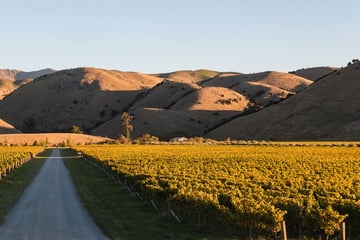
Setting: The first stop on the Classic New Zealand Wine Trail, Hawke's Bay is a serious producer of full-bodied reds and excellent chardonnay, paired with Napier's striking Art Deco streetscape and 125 miles of easy cycling between cellar doors.
See and do: Cycling between the region's 72 wineries is the classic way to spend a day here — Te Mata Estate, Craggy Range and Mission Estate are among the standouts. Marine Parade in Napier is worth an evening stroll, and MTG Hawke's Bay combines museum, theatre and gallery under one roof.
Star attraction: The Food and Wine Classic (FAWC), held twice yearly in June and November, brings together the region's best chefs and growers for a genuinely excellent multi-day celebration of local produce.
Stay at The Farm at Cape Kidnappers for one of the finest bases in the region.
Setting: New Zealand's farming heartland, Manawatu sweeps from the Tararua and Ruahine ranges down to the Tasman coast, offering award-winning gardens, horse trekking and quiet cycling routes through farmland villages.
See and do: The Manawatu Golf Club is the country's oldest course, while the Manawatu Gorge Scenic Reserve offers excellent walking and cycling. Palmerston North's Victoria Esplanade Gardens, with 5,000 roses, is a genuinely lovely stop in bloom.
Star attraction: The New Zealand Rugby Museum in Palmerston North holds the country's largest collection of rugby memorabilia, including jerseys and boots dating back well over a century — a must for any rugby fan passing through.

Setting: Built around the 180-mile Whanganui River on the North Island's lower west coast, Whanganui was one of the country's earliest founded cities and blends heritage architecture with genuinely dramatic river-valley scenery.
See and do: Explore Whanganui National Park by jet boat, kayak or aboard the historic paddlewheeler PS Waimarie. Bushy Park Wildlife Sanctuary is worth the detour for rare native birds among towering trees, and the 113-metre Durie Hill War Tower offers sweeping views as a WWI memorial.
Star attraction: With more than 400 resident artists, Whanganui has a genuinely thriving creative scene — Sarjeant on the Quay, the Quartz Museum of Studio Ceramics and New Zealand Glassworks, where you can watch glass being blown up close, are all worth building into a stop.

Setting: New Zealand's compact capital, proudly nicknamed the "coolest little capital in the world," sits between the Cook Strait and the Rimutaka Range and blends history, coffee culture and film industry pedigree with genuine outdoor access on its doorstep.
See and do: Te Papa Tongarewa is essential for a proper introduction to the country's natural and cultural history, while Courtenay Place, Cuba Street and the Queens Wharf waterfront cover the city's best eating and drinking. The Wellington Cable Car, New Zealand's only functioning funicular, runs from Lambton Quay up to Kelburn and the botanic gardens above.
Star attraction: Weta Workshop's behind-the-scenes tours reveal the craft behind The Lord of the Rings and The Hobbit trilogies, and a full-day Lord of the Rings location tour around the city satisfies any Middle-earth completionist.

Setting: Bordered by the Tararua Mountains and the Pacific, Wairarapa is a region of dramatic coastline and five distinct towns — Martinborough, Featherston, Greytown, Carterton and Masterton — each with its own character.
See and do: The Pukaha Mount Bruce National Wildlife Centre is home to rare native birds, including the world's only white kiwi in captivity. The Remutaka Cycle Trail offers peaceful lake and ocean views, and Greytown's well-preserved Victorian streetscape is a lovely, unhurried stop.
Star attraction: Martinborough produces some of New Zealand's finest pinot noir, and a self-guided walk or cycle between its 30-plus boutique, largely family-owned wineries is one of the best low-key days out on the North Island — just book ahead, as most cellar doors require it.

However short or long your trip, we'd always encourage building in real time rather than rushing between regions — the North Island rewards a slower pace, and having planned routes here for over twenty years, we know exactly which stops deserve an extra night. Browse our North Island tours, explore our self-drive holidays for total flexibility, or request your free New Zealand travel guide to start planning your route.
How long do I need to properly explore the North Island?
We'd suggest a minimum of 10-12 nights to cover the highlights without rushing — Northland, Rotorua, Taupo, Hawke's Bay and Wellington alone could easily fill that. If you're combining both islands, we'd usually recommend at least three weeks in total.
Which North Island region is best for wine lovers?
Hawke's Bay and Wairarapa are the two standouts. Hawke's Bay excels in full-bodied reds and chardonnay with easy cycling between cellar doors, while Wairarapa's Martinborough is New Zealand's pinot noir heartland on a more intimate, boutique scale.
Is the North Island suitable for Lord of the Rings fans?
Very much so — Hamilton-Waikato is home to the Hobbiton Movie Set, and Wellington offers Weta Workshop tours and location-based city tours. Our Lord of the Rings Scenic Explorer Self-Drive is built specifically around these sites.
Can I visit Whakaari/White Island as part of a North Island trip?
Access is possible via guided boat or helicopter tours from the Bay of Plenty, but the volcano is genuinely active and access has been restricted at times in the past, so always check current availability with your travel advisor before relying on it as a fixed part of your itinerary.
What's the best way to see multiple North Island regions without missing the highlights?
A self-drive gives you the flexibility to add extra nights wherever a region grabs you, while an escorted tour takes the planning off your hands entirely. Either way, our specialists can build a route around the regions that matter most to you, rather than a one-size-fits-all itinerary.

Sign up to our newsletter
Be the first to know about our exclusive offers and holiday inspiration by email.