
Useful Australia Travel Information

Skiing in Queenstown

EMERGENCIES AND EMERGENCY TEXT

The emergency telephone number in New Zealand is 111. It is a free phone call. If you have an emergency and need a quick response from the Police, the Fire Service, Ambulance or Search and Rescue, dial 111.

Keeping Safe Via Text Messaging

New Zealand's two main mobile phone providers offer a txt messaging service for visitors.

You can send updates about your location and travel movements via txt to number 7233 [SAFE]. These details are kept on a central database which can be accessed by police if necessary.

Each text message sent to 7233 will be acknowledged by an automated response, which advises you to call 111 and request police assistance if you are in danger.

Police and the New Zealand tourism industry encourage you to use this service as another way of letting people know where you are and what you are doing while in our country.

CLIMATE

The north of New Zealand is subtropical and the south temperate. The warmest months are December, January and February, and the coldest June, July and August.

In summer, the average maximum temperature ranges between 20-30ºC and in winter between 10-15ºC. You can check on weather conditions in New Zealand on the New Zealand Met Service website.

While these temperatures are the norm, the weather in New Zealand can change unexpectedly as cold fronts or tropical cyclones quickly blow in. Because of this, you should be prepared for sudden changes in weather and temperature, particularly if you’re going hiking or doing other outdoor activities.

PEOPLE AND HISTORY OF NEW ZEALAND

New Zealand is an independent nation and a member of the British Commonwealth. It has a diverse multi-cultural population of 4 million people, the majority of whom are of British descent. New Zealand's indigenous Maori make up around 14 percent of the population.

Early Settlement

The Maori were New Zealand's first settlers. They made an epic journey from the legendary Hawaiki, probably in Polynesia to the north of New Zealand, about 1000 years ago. The great explorer Kupe, who legend says first discovered New Zealand, named the new land Aotearoa - Land of the Long White Cloud.

The first documented European to discover New Zealand was Dutch navigator Abel Tasman, who came here in 1642 in search of the fabled great southern continent. Over a 125 years later, Captain James Cook claimed it for Britain in 1769 and produced a map of the country.

The Treaty of Waitangi

The Treaty of Waitangi , seen as New Zealand's founding document, established the country as a nation. It was signed in 1840 between leading Maori chiefs and representatives of the British Crown at Waitangi, in the Bay of Islands, now one of the country's most historic sites. The signing of the treaty began on 6 February, which has become New Zealand's national day, known as 'Waitangi Day'.

RECOMMENDED CLOTHING

Dress is informal and relaxed on most occasions. Smart casual clothes are acceptable at most restaurants and night-spots. Men are generally not expected to wear suits and ties, except in a few of the top formal bars and restaurants in major cities.

In summer a jacket and sweater should be included in your luggage should the weather turn cooler or you visit higher altitudes. You can expect some rain, so also include a light rainproof jacket or coat. If visiting between May and September, pack warm winter garments and layer your clothing.

DRIVING

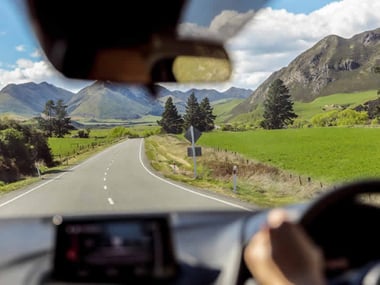
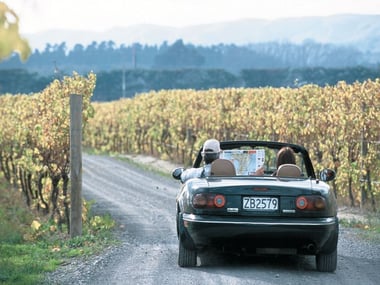
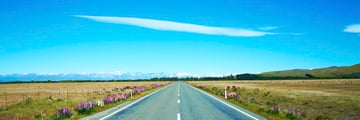
To make life easier, the Kiwi’s drive on the same side of the road as in the UK.

In New Zealand all drivers, including visitors from other countries, must carry their licence or permit at all times when driving. You will only be able to drive the same types of vehicles you are licensed to drive in your home country. The common legal age to rent a car in New Zealand is 21 years.

Make sure your driver's licence is current. If your licence is not in English, you must bring an English translation with you or obtain an IDP. Contact your local automobile club for further details about obtaining a translation or an IDP.

TRAMPING / HIKING

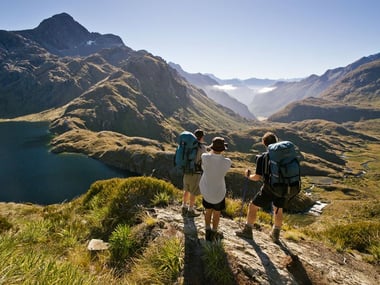
Be prepared is the order of the day. If you are planning to take off on one of the fabulous tracks, make sure you are well prepared and inform someone of your intentions and stop off points. Contact the local Park Rangers before setting off and get all the advice you can.

CREEPY CRAWLIES

Yipeeeeeee. There are none really. Possums can scare the living daylights out of you but are harmless.

PERSONAL DETAILS

We recommend you give a copy of your itinerary to a friend or relative at home with contact telephone numbers. We also advise you to take a copy of your passport (last 2 pages with photo on it).

TRAVELLING WITH CHILDREN

  1. If you are travelling outside of school holidays remember to get permission from the head teacher and fill in the correct forms. You could encourage your kids to keep a travel journal so that they can take it into school on their return and show that holidays can be a learning experience as well.
  2. Get your children interested in the local language, currency and culture; it makes the simplest of excursions exciting and adventurous.
  3. Limit the use of hand held computer games, they will get more out the holiday if they take part in it and so will you.
  4. On board luggage rules do change so it worth checking what you can and cannot take in terms of food and drink nearer your travel date. You should be aiming to get onboard with lots of water (you can buy it airside) and snacks which you can all have. Almonds, carrots, sandwiches and sucky sweets for take-off are useful.
  5. Remember to request bassinet seats for babies and children’s meals where necessary. Frequently the children’s meals are full of chocolate and junk so if your child is a good eater stick with the adult food and take whatever sweet stuff suits you.
  6. Take extra underwear for the kids and spare socks. Remember ‘planes are often chilly on night flights so take a jumper. Layer the clothing and leave enough hand-luggage room to stash it if you are going to the tropics. Leave your flip-flops in an outer checked luggage pocket so you can retrieve them and change your footwear before you make your onward journey.
  7. Onboard distractions should be noiseless and without lots of bits which will get lost. Also felt tips can be a pain for careless or younger kids because you lose the tops all the time and they leak all over your clothes. Most long-haul airlines have TV screens in the back of the seats which have gaming consuls on and a choice of entertainment.
  8. Take your child to the loo regularly. Stops accidents and gets you to stretch your legs as well. Also your child can move around a bit which burns off a bit of energy.
  9. The children’s hand luggage is best stored in their own bag and then put in your bag. Children under 8 and bags don’t seem to mix and their forgotten bag becomes a security risk. The easiest thing to do is count how many adult hands there are and have no more bags than that.
  10. Check passport requirements – children must have their own and they expire after 5 years when you must update them. Many countries require your passport to have a minimum of 6 months validity left in them.

ELECTRICITY

Electricity is supplied throughout New Zealand at 230/240 volts, 50 hertz. Most hotels and motels provide 110 volt ac sockets (rated at 20 watts) for electric razors only.

For all other equipment, an adapter/converter is necessary, unless the item has a multi-voltage option. Please note that power outlets only accept angled two or three pin Type I plugs (as also used in Australia) depending on whether an earth connection is fitted.

TIME ZONE

New Zealand is one of the first places in the world to see the new day, 12 hours ahead of GMT (Greenwich Mean Time). In summer New Zealand uses ‘daylight saving’, with clocks put forward one hour to GMT+13. Daylight saving begins on the last Sunday in September and ends on the first Sunday of the following April, when clocks are put back to GMT+12.

Ask us a question


Alternatively, call our travel experts who will be happy to answer your questions

01342 310 581

Receive Holiday Offers & News by Email

Your money is safe with New Zealand Sky

The air holiday packages shown are ATOL protected by the Civil Aviation Authority. Our ATOL number is ATOL 9759. Please see our booking conditions for more information.

CAA (ATOL 9759) ABTA (Y0499)