


13 nights
From
£3,499
pp

For over twenty years, our passionate destination specialists at New Zealand Sky have helped travellers craft unforgettable journeys to the edge of the world. Yet, when clients ask us what truly transforms a trip to New Zealand from a scenic holiday into a soul-stirring, life-changing journey, our answer is always the same: it is an immersion into the living heart of Maori culture.
To really understand New Zealand, you must understand the indigenous Maori people. Arriving in ocean-going canoes (waka) over 700 years ago, they brought rich Polynesian customs that have uniquely shaped the modern kiwi identity. From the striking geometry of sacred tattoos to the warmth of underground pit cooking, powerful legends, and the spine-tingling tremor of the haka, this is our expert introduction to Maori culture—and the most authentic places to experience it.

The Maori people of New Zealand, historically known as the Tangata Whenua (the "People of the Land"), trace their ancestry back to Hawaiki—a mythical, ancestral homeland in Eastern Polynesia. Guided by the stars, ocean swells, and flight paths of birds, these master navigators crossed the vast Pacific in the 13th century, landing on shores they named Aotearoa: "The Land of the Long White Cloud".
In 1840, the path of Maori history shifted permanently with the signing of the Treaty of Waitangi (Te Tiriti o Waitangi) between representative Maori chiefs and the British Crown. Today, you can explore the preserved treaty grounds on our curated North to South and All That's Inbetween 30 Day Self-Drive, which stops right in the historic Bay of Islands.

Maori culture remains a central pillar of New Zealand's modern identity. Maori people represent roughly 17 percent of the national population. While you will encounter cultural heritage across both islands, the vibrant epicentre remains the North Island—particularly around Auckland, the Bay of Plenty, and the geothermal valleys of Rotorua. A sweeping renaissance of the Maori language (Te Reo) and deep-rooted, community-led tourism initiatives ensure these ancestral traditions are not static museum pieces, but a vibrant, lived reality.
To appreciate Maori culture, it helps to understand Whanaungatanga, which is the profound sense of connection and relationship to family, community, and the physical land. These ancestral threads are woven through everyday life.
The marae meeting grounds
The spiritual and social focal point of any Maori community is the marae, a sacred communal complex of ornately carved buildings. When we arrange for you to visit a marae, you are stepping onto sacred ground. The focal point is the wharenui (meeting house), structured to physically represent the body of a tribal ancestor: the ridgepole is the spine, the rafters represent the ribs, and the front bargeboards are the welcoming, outstretched arms. It is a place of deep respect, intense debate, and joyous celebration.

Te Reo is New Zealand’s treasured official language. Historically entirely oral, it has been preserved through generation after generation of rhythmic songs (waiata) and spoken histories. Today, a new generation is growing up fluent, thanks to community immersion initiatives. On your travels, you will hear the language everywhere. The most essential phrase to learn is Kia ora (a warm greeting wishing health and life), alongside Haere mai (welcome).
Maori culture is rich with powerful mythology that explains the physical world. If you listen closely during a cultural evening, you will hear tales of star-crossed lovers like Hinemoa and Tutanekai on the shores of Lake Rotorua, or the epic journey of Paikea, the Whale Rider, who rode on the back of the great whale Tohora to the East Coast.
The ultimate epic, however, belongs to Maui, the clever, mischievous demigod. According to creation stories, Maui used a magic hook carved from his grandmother’s jawbone to pull up a giant fish from the deep. That fish became the North Island (Te Ika-a-Maui). Look closely at a map: Wellington Harbour forms the fish's mouth, and the far north of Auckland represents the tail. The South Island (Te Waipounamu) is Maui’s sturdy wooden canoe, while Stewart Island (Rakiura) acts as the heavy stone anchor holding it in place.
A hangi is much more than a dinner; it is an incredible communal cooking method developed over centuries. An earth oven is dug into the ground, lined with river stones, and heated by an open wood fire. Once the stones are white-hot, baskets of meat (typically wild pork, lamb, and chicken) and root vegetables like kumara (sweet potato) are placed inside. Wrapped in damp sacking and buried with earth, the food slow-cooks in its own juices and mineral steam for several hours. The result? A spectacularly tender, melt-in-the-mouth feast kissed with a distinctively earthy, smoky aroma.

Storytelling takes a physical, stunning form in Maori craftsmanship. Master weavers make garments from native flax, while master carvers (tohunga whakairo) carve stories into native wood, bone, and precious pounamu (greenstone).
The most sacred art form is ta moko, which is traditional skin carving. Unlike ink tattoos, moko is traditionally carved into the skin using bone chisels, leaving a textured surface. It is a highly sacred visual CV, mapping the wearer's lineage, accomplishments, and social standing. Men traditionally receive moko on their faces, thighs, and buttocks, while women wear theirs proudly on the lips and chin (moko kauae).

Dance is the ultimate, physical expression of Maori identity. Women often perform the poi, gracefully twirling soft balls attached to flax cords in mesmerizing, rhythmic synchronization to represent the movement of native birds or water.

But it is the haka that commands the world’s attention. Though made famous globally by the fearsome pre-match displays of the All Blacks rugby team, the haka is much more than a war dance. While historically used to intimidate enemies on the battlefield, it is also performed to welcome honored guests, celebrate milestones, and express deep grief or respect.
The legendary roots of the dance are lighter. Myth says a chief named Tinirau sent a group of women to find a priest named Kae, who had killed the chief's pet whale. To identify him without raising alarm, the women performed a humorous, spirited haka to make the villagers laugh, knowing Kae had distinctively overlapping, crooked teeth. When he smiled, his identity was revealed.
Today, watching a haka up close (hearing the booming chest slaps, the synchronized, earth-shaking foot-stomping, and seeing the fierce, bulging eyes (pukana) and protruding tongues) is a sensory experience that will leave you with goosebumps.

Visiting a marae is a profound honour. To enter, you will participate in a powhiri, which is a formal welcoming ceremony. The ritual begins with the wero (challenge), where a Maori warrior will advance on the visitors (manuhiri) to determine if they come in peace, placing a small token (often a silver fern leaf) on the ground. The designated leader of your group must pick this up while keeping eye contact.
Once peaceful intentions are established, a woman from the host tribe will call out a haunting karanga (welcome chant), guiding you inside. After formal speeches and songs, the welcome is sealed with the hongi, the beautiful custom of pressing your nose and forehead together. In this quiet moment, you share the ha (the breath of life), transforming from strangers into family.
These experiences culminate in rich storytelling, hands-on weaving, a tour of the grounds, and a magnificent hangi feast.

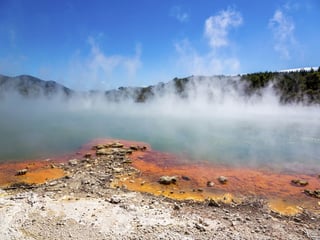
Most of the country’s immersive cultural encounters are concentrated in the North Island, particularly around the thermal wonderland of Rotorua. However, brilliant experiences can be found nationwide. We highly recommend weaving several of these stops into our ultimate Grand New Zealand self-drive itinerary.
During your trip to New Zealand, be sure to visit important Maori sites like the Waitangi Treaty Grounds and Tongariro National Park, which has been listed by UNESCO for its Maori spiritual and cultural values. You may also come across reconstructions of pre-European settlements, especially in the North Island. A popular one is Rewa’s Village in Kerikeri, a replica Maori fishing village which you can explore on a self-guided tour.

New Zealand is also home to some world-class museums where you can learn about Maori culture in a less performative setting. The Auckland Museum boasts the largest collection of Maori artefacts in the world, including a canoe, meeting house, weapons and costumes. Located an hour from Christchurch, the Okains Bay Maori and Colonial Museum also tells the story of Maori life and European settlement, while the Te Papa Museum in Wellington is home to Maori objects such as clothes, weapons and carvings.
If you prefer to explore history at your own pace, New Zealand is home to world-class museums.
What is the correct etiquette when visiting a Marae?
Always wait to be formally invited onto the marae grounds through a powhiri (welcoming ceremony); never just walk in. Dress respectfully (smart-casual), remove your shoes before entering the wharenui (meeting house), and ask for permission before taking any photos, especially during formal ceremonies.
Is the food served at a Hangi safe for dietary requirements?
Yes, absolutely! While a traditional hangi consists of meat and root vegetables slow-cooked in the ground, modern operators are exceptionally accommodating. Because the ingredients are steamed naturally without oils or gluten, it is naturally very clean. Vegetarian, vegan, and gluten-free options are easily catered to; just let our travel specialists know when booking.
What is the significance of the Hongi, and do tourists have to do it?
The hongi is the traditional greeting of pressing noses and foreheads together, symbolizing the sharing of the "breath of life". While it is a beautiful, intimate gesture, there is no pressure. If you are uncomfortable, a respectful nod, a warm smile, or a gentle handshake is completely acceptable and understood by hosts.
When is the best time of year to experience these cultural tours?
While indoor museum exhibits and most Rotorua cultural shows operate year-round, outdoor forest walks (like Footprints Waipoua) are most comfortable during the warmer, drier months from October to April. Booking in advance is highly recommended, especially during the peak summer holiday season (December to February).
Can children participate in these Maori cultural experiences?
Yes, they are wonderfully family-friendly! Children are warmly welcomed, and they often love the highly interactive elements, such as learning the poi dance, watching the energetic haka, or tasting the delicious roasted sweet potatoes from the hangi.




Sign up to our newsletter
Be the first to know about our exclusive offers and holiday inspiration by email.